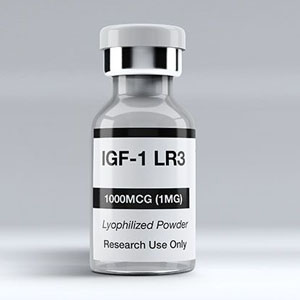
IGF-1LR3
Price range: $60.00 through $300.00
Order IGF-1LR3 (1mg) – High-Potency Long R3 Analogue
Optimize your cellular growth studies with IGF-1LR3, the most effective and long-lasting analogue of Insulin-like Growth Factor-1. Specially engineered for research stability, this 83-amino acid polypeptide features a structural modification that allows it to bypass IGF-binding proteins, resulting in a significantly extended half-life and up to 3 times the potency of standard IGF-1.
Product Highlights:
-
Extended Bioavailability: Designed to resist binding proteins (IGFBPs) for a half-life of 20–30 hours.
-
Hyperplasia Research: The primary research tool for studying satellite cell proliferation and new muscle fiber development.
-
Metabolic Efficiency: Studied for its role in increasing amino acid transport and glucose uptake in cellular models.
-
Laboratory Grade: Guaranteed 98% or higher purity (HPLC/MS verified) in a stable, lyophilized format.
IGF-1LR3 is the preferred choice for researchers requiring sustained IGF-1 activity to observe long-term effects on tissue repair, protein synthesis, and metabolic regulation.
IGF-1LR3 Peptide: Long-Lasting Insulin-like Growth Factor Analogue for Advanced Research
When you choose IGF-1LR3 (Long R3 Insulin-like Growth Factor-1) for your laboratory experiments, you are utilizing a highly potent, synthetic analogue of human IGF-1. Specifically designed for enhanced biological activity, IGF-1LR3 is a 83-amino acid polypeptide that includes a substitution of Glutamic Acid for Arginine at position 3, as well as a 13-amino acid extension at the N-terminus. These modifications are critical for researchers seeking to bypass the inhibitory effects of IGF-binding proteins (IGFBPs).
What is IGF-1LR3?
Standard IGF-1 has a very short half-life in the bloodstream because it quickly binds to IGFBPs, which neutralize its activity. IGF-1LR3 was engineered to solve this limitation. Due to its structural modifications, it has a significantly lower affinity for these binding proteins, resulting in a much longer half-life (approximately 20–30 hours) and increased potency.
Researchers utilize IGF-1LR3 to study cellular signaling, hyperplasia (the creation of new muscle cells), and the regulation of glucose and amino acid transport across cell membranes.
Key Research Benefits and Mechanism of Action
Incorporating IGF-1LR3 into your research protocols offers deep insights into growth and metabolic pathways:
-
Muscle Hyperplasia Research: Unlike many other growth factors that only increase the size of existing cells (hypertrophy), IGF-1LR3 is a primary subject in studies regarding the proliferation of satellite cells and the creation of new muscle fibers.
-
Enhanced Nutrient Transport: It is studied for its ability to significantly increase the uptake of amino acids and glucose into cells, making it a vital tool for metabolic and performance research.
-
IGFBP Resistance: Because it does not bind strongly to IGFBPs, it remains biologically active in the system for extended periods, allowing for more consistent experimental observations.
-
Cellular Longevity & Repair: Studies explore its role in stimulating DNA synthesis and cellular repair mechanisms across various tissue types, including connective and skeletal tissues.
Technical Specifications
To ensure the integrity of your data, verify that your IGF-1LR3 meets these professional standards:
-
CAS Number: 946870-92-4
-
Molecular Formula: C391H612N112O115S8
-
Molecular Weight: 9111.6 g/mol
-
Purity: 98% or higher (HPLC and Mass Spectrometry verified)
-
Appearance: Fine white lyophilized powder
-
Solubility: Soluble in 10mM Acetic Acid or Sterile Water
Handling and Storage Guidelines
To maintain the stability and bioactivity of IGF-1LR3:
-
Long-term Storage: Store the lyophilized powder at -20 degrees Celsius. For storage exceeding 12 months, -80 degrees Celsius is recommended.
-
Reconstitution: Use a dilute acid (such as 10mM Acetic Acid) for initial dissolution before further dilution with a buffer or sterile water to prevent the peptide from “clumping” or sticking to the vial.
-
Stability: Once reconstituted, the solution is highly sensitive. Keep refrigerated at 2 to 8 degrees Celsius and use within 7 to 10 days for peak activity.
Why Research with IGF-1LR3?
In the landscape of 2026, IGF-1LR3 remains a critical component in the study of regenerative medicine and sports science. Its ability to maintain potency while avoiding the metabolic “shutdown” caused by binding proteins makes it vastly superior to native IGF-1 for in vitro and in vivo models. Always request a full Certificate of Analysis (CoA) to verify the sequence and the absence of bacterial endotoxins.
Research Disclaimer: This product is intended strictly for laboratory research and in vitro use.
| Quantity | 0.1mg*10vials, 1mg*10vials |
|---|
Be the first to review “IGF-1LR3”
Related products
Product
Product
Product
Product
Product
Product
Product
Product
Reviews
There are no reviews yet.