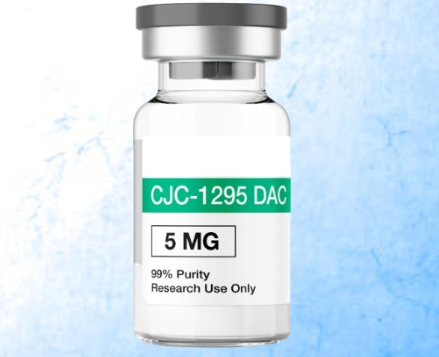
CJC-1295 DAC Peptide
Price range: $70.00 through $140.00
Buy CJC-1295 DAC – Long-Acting Growth Hormone Releasing Hormone Analogue
Optimize your endocrine research with CJC-1295 DAC, a high-purity GHRH analogue engineered for extended bioactivity. By incorporating the Drug Affinity Complex (DAC), this peptide achieves a superior half-life of 6–8 days, allowing for sustained stimulation of the anterior pituitary gland. It is an essential tool for researchers studying long-term growth hormone secretion, IGF-1 signaling pathways, and systemic metabolic regulation.
Product Highlights:
-
Extended Half-Life: Utilizes DAC technology to bond with circulating albumin, providing prolonged active research windows.
-
Endogenous Secretion: Signals the pituitary to increase natural GH production while maintaining physiological pulsatility.
-
Metabolic & Tissue Repair: A primary subject for studies involving lipolysis, muscle protein synthesis, and collagen repair.
-
Scientific Excellence: Guaranteed 99% or higher purity (HPLC/MS verified) in a stable, lyophilized format for consistent data.
CJC-1295 DAC is the gold standard for laboratory models requiring chronic growth hormone elevation without the need for frequent daily administration.
Note: For laboratory research use only.
CJC-1295 DAC: The Definitive Research Guide to the Long-Acting GHRH Analogue
In the sophisticated field of endocrinology and molecular research, CJC-1295 DAC represents a pinnacle of peptide engineering. Originally developed to treat growth hormone deficiencies, this synthetic analogue of Growth Hormone-Releasing Hormone (GHRH) has become a primary subject of study for its ability to stimulate the anterior pituitary gland with unprecedented efficiency. By incorporating the Drug Affinity Complex (DAC), this peptide overcomes the inherent biological limitations of standard GHRH, providing researchers with a unique window into sustained somatotropic signaling.
1. Understanding the Molecular Architecture
CJC-1295 DAC is a tetra-substituted 30-amino acid peptide. Its primary sequence is derived from the first 29 amino acids of GHRH (often referred to as Sermorelin), which is the shortest functional fragment of the hormone. The “DAC” modification is what sets this compound apart. The Drug Affinity Complex (N-epsilon-maleimidopropionyl-Lysine) is a chemical group that allows the peptide to bond covalently to circulating albumin after administration.
The Role of Albumin Conjugation
In its natural state, GHRH has a half-life of mere minutes due to rapid enzymatic cleavage. When you utilize CJC-1295 DAC in a laboratory setting, the peptide hitches a ride on albumin—the most abundant protein in the blood. Because albumin has a half-life of nearly 20 days, it protects the CJC-1295 molecule from degradation, extending its active research window to 6–8 days.
2. Mechanism of Action: Endogenous Secretion vs. Exogenous Administration
The most critical distinction of CJC-1295 DAC is that it is a secretagogue. Unlike synthetic Human Growth Hormone (HGH), which replaces natural levels with a foreign substance, CJC-1295 DAC signals the research subject’s own pituitary gland to manufacture and release its own GH.
The GHRH Receptor (GHRHR) Interaction
CJC-1295 DAC binds to the GHRH receptors located on the somatotroph cells of the anterior pituitary. This binding triggers a cascade of intracellular signaling:
- Adenylate Cyclase Activation: Increases cAMP levels within the cell.
- Protein Kinase A (PKA) Pathway: Opens calcium channels, leading to the fusion of GH-containing vesicles with the cell membrane.
- Sustained Pulsatility: Research indicates that CJC-1295 DAC raises baseline levels while allowing the body to maintain its natural pulsatile rhythm of GH release.
3. The IGF-1 Cascade: The Engine of Regeneration
The research value of CJC-1295 DAC is often measured by its impact on Insulin-like Growth Factor 1 (IGF-1). Once the pituitary releases Growth Hormone into the systemic circulation, it travels to the liver, where it stimulates the synthesis of IGF-1. Researchers studying CJC-1295 DAC typically focus on:
- Hyperplasia: The creation of new muscle cells, rather than just the enlargement of existing ones (hypertrophy).
- Nitrogen Retention: Studying the peptide’s ability to maintain a positive nitrogen balance, essential for tissue repair and anti-catabolic research.
- Collagen Synthesis: Investigating how sustained GH/IGF-1 levels influence the repair of ligaments, tendons, and skin elasticity.
4. Key Research Applications and Scientific Observations
Because of its extended half-life, CJC-1295 DAC is the preferred choice for long-term longitudinal studies where frequent daily administration would interfere with the research model.
Metabolic and Lipolytic Research
- Lipolysis: The breakdown of stored triglycerides in adipose tissue.
- Glucose Regulation: Studies on how sustained GH elevation impacts insulin sensitivity and glucose uptake in muscle cells.
- Basal Metabolic Rate (BMR): Monitoring changes in energy expenditure during prolonged GHRH stimulation.
Sleep Architecture and Neurological Recovery
- Delta Wave Sleep: Research into whether sustained GHRH signaling improves the quality of deep, restorative sleep.
- Neural Repair: The role of the GH/IGF-1 axis in protecting neurons from oxidative stress and promoting neurogenesis.
5. CJC-1295 DAC vs. Mod GRF 1-29 (CJC-1295 No DAC)
| Feature | CJC-1295 DAC | CJC-1295 No DAC (Mod GRF) |
|---|---|---|
| Half-Life | ~6–8 Days | ~30 Minutes |
| Binding | Covalent bond to Albumin | No specific protein binding |
| GH Release | Constant, elevated baseline | Acute, short-lived pulse |
| Research Goal | Chronic GH elevation | Mimicking natural pulses |
6. Technical Product Specifications
- Molecular Formula: C165H269N47O46
- Molecular Weight: 3647.25 g/mol
- Sequence: Tyr-D-Ala-Asp-Ala-Ile-Phe-Thr-Gln-Ser-Tyr-Arg-Lys-Val-Leu-Ala-Gln-Leu-Ser-Ala-Arg-Lys-Leu-Leu-Gln-Asp-Ile-Leu-Ser-Arg-Lys(DAC)-NH2
- Purity: Guaranteed 99% or higher (HPLC and Mass Spectrometry verified).
- Appearance: Fine white lyophilized (freeze-dried) powder.
7. Reconstitution, Handling, and Storage Protocols
The 30-amino acid chain of CJC-1295 DAC is physically fragile. To preserve the bioactivity of the DAC complex, researchers must follow precise handling protocols.
- Selection of Diluent: Use sterile bacteriostatic water for multi-use vials.
- Gentle Dissolution: Aim the water at the side of the vial. Do not spray directly onto the powder. Swirl the vial with a slow, circular motion. Never shake the vial.
- Storage Stability: Store lyophilized powder at -20°C for up to 24 months. Once reconstituted, store at 2°C to 8°C and use within 21–30 days.
8. Safety and Environmental Factors in Research
Researchers must verify that their peptide is free from Trifluoroacetic acid (TFA), a common byproduct of peptide synthesis that can be toxic to cell cultures. Our CJC-1295 DAC undergoes a specialized TFA-removal process to ensure a safe and neutral research environment.
9. Summary of Scientific Potential
In 2026, CJC-1295 DAC remains a vital candidate for research into aging, muscle wasting diseases, and metabolic disorders. Its unique ability to provide sustained GHRH activity without the need for constant re-administration makes it an unparalleled tool for modern science. By raising the GH baseline while maintaining physiological pulsatility, it offers a “best of both worlds” approach to somatotropic research.
| Quantity | 2mg*10vials, 5mg*10vials |
|---|
Be the first to review “CJC-1295 DAC Peptide”
Related products
Product
Product
Product
Product
Product
Product
Product
Product
Reviews
There are no reviews yet.